

Software developers
Run your controller against a predictable rig: discovery, GET and SET, sensors and error paths, reproducible from one config file and controllable over a REST API.
QubiResponder joins your network as an Art-Net node with a rig of simulated RDM fixtures behind it. Point QubiSet or your own software at it and exercise discovery, configuration and monitoring without a case of hardware.
See QubiResponder in action
Every screen below is the built-in web interface of one running QubiResponder, simulating ten fixtures on a single laptop.
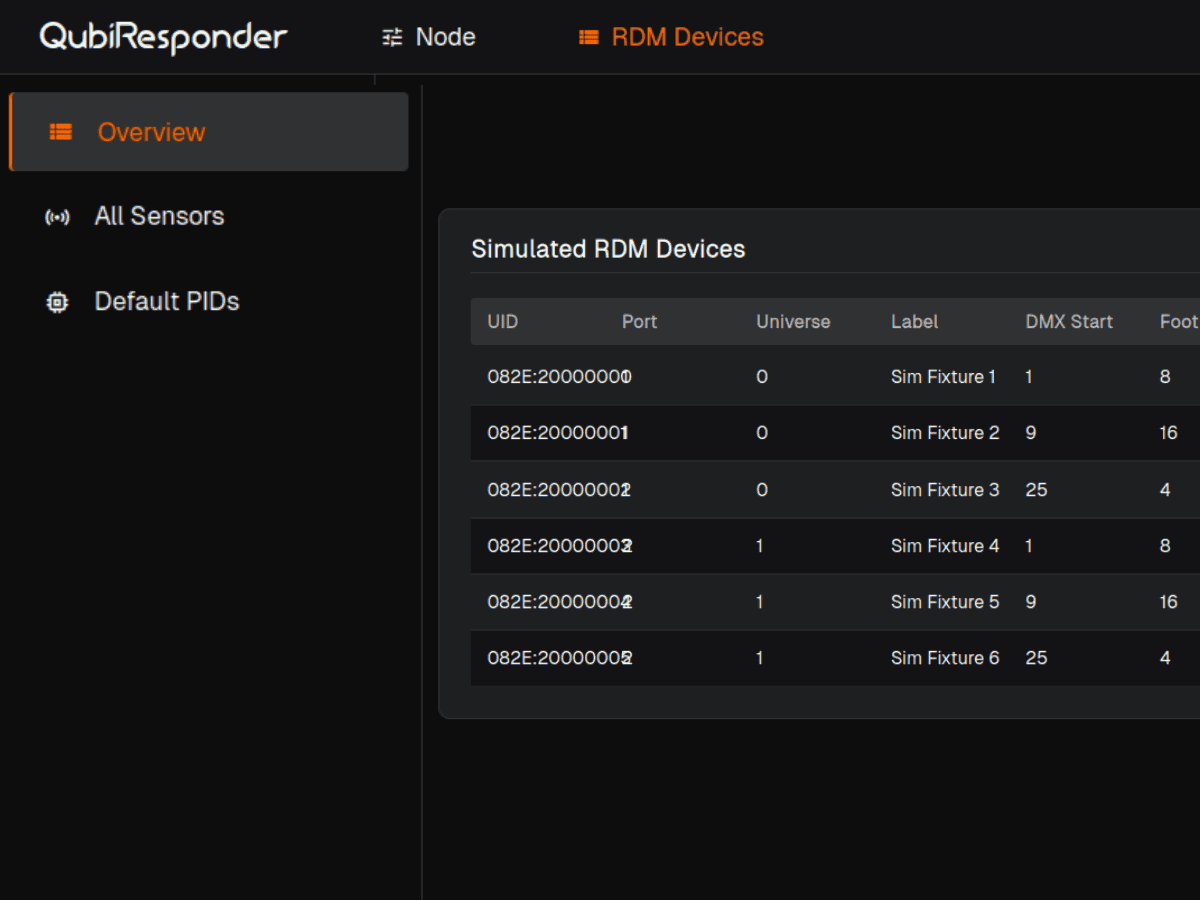
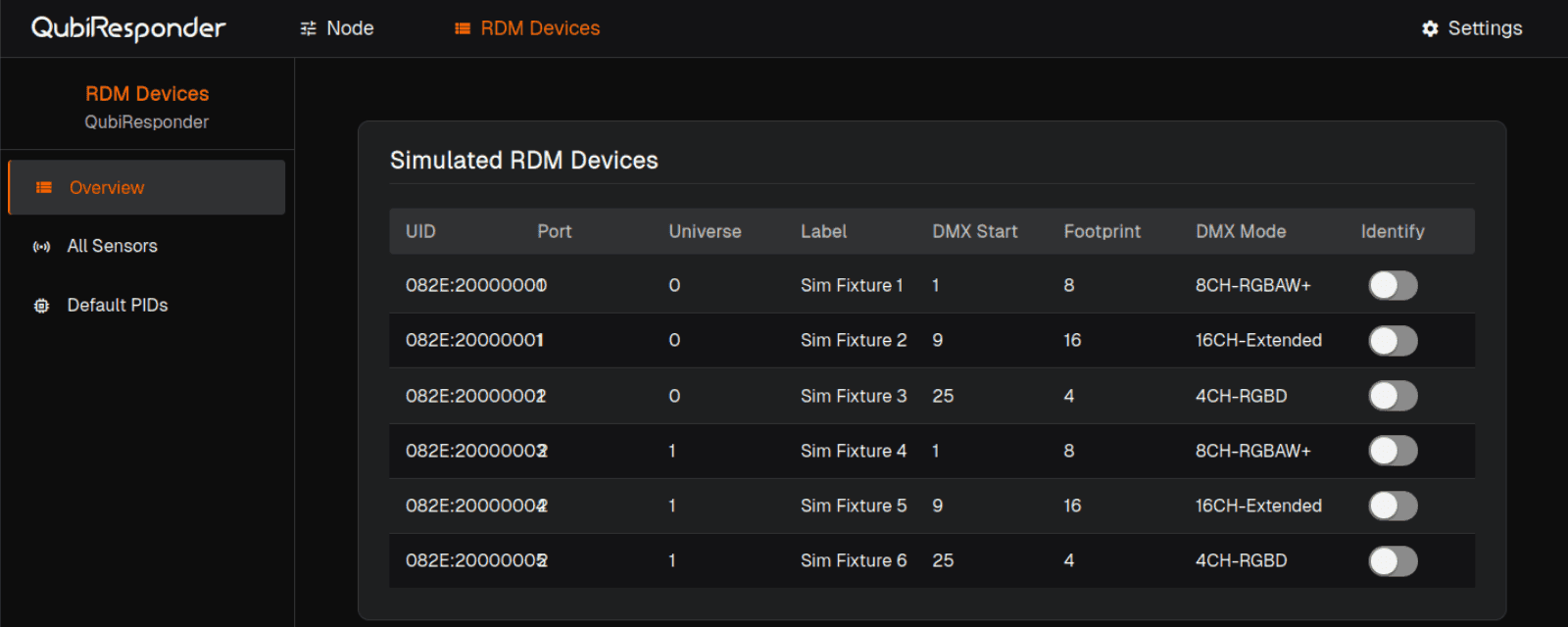
Each simulated fixture answers discovery and RDM commands like real hardware, with its own labels, DMX address, footprint, personality, sensors and identify state.
QubiResponder is the responder our own QubiSet end-to-end tests run against, and it is just as useful outside our walls.
Run your controller against a predictable rig: discovery, GET and SET, sensors and error paths, reproducible from one config file and controllable over a REST API.
Rehearse how your tools behave against devices that misbehave on purpose: queued responses, timeouts, collisions and failed uploads, injected on demand.
Practice RDM workflows on a simulated rig before touching the real one, and run training sessions anywhere a laptop goes.
A simulator is only useful when it is faithful. QubiResponder implements the management protocols real fixtures speak and reproduces the imperfections real fixtures show, so what passes against it holds up in the venue.
QubiResponder appears as an Art-Net 4 node with RDM responders behind it, and answers LLRP discovery and configuration over IP. These are the protocols your tools use to find, identify and configure a rig.
Responses can honor configurable DMX wire timing, queue behind ACK timers, collide and be discarded or corrupted, or fail in exactly the way you ask for through the failure injection API.
A config-driven subset of Netron HTTP endpoints, including the firmware upload flow, verified against the real Netron firmware update tooling.
Simulated devices can expose virtual files for upload and download over RDM E1.37-4 file transfer, with per-file policies for testing tools that ship firmware or fixture data.
QubiResponder Free is a fixed rig of ten simulated fixtures under the QubiCast manufacturer ID. The paid plan makes the rig yours to shape.
A fixed test rig, free with a QubiCast account.
The full simulator for serious test setups.
QubiResponder Free comes with a QubiCast account: claim it in your product library and sign in from the QubiResponder web interface to activate it.
Open your product libraryQubiResponder Free includes ten simulated fixtures. The paid plan removes the limit.
Answers about what QubiResponder simulates and how to run it.
A network node speaking Art-Net 4, with simulated RDM fixtures behind it, LLRP discovery and configuration, and a Netron-compatible HTTP interface. Each fixture carries its own identity: labels, DMX start address, footprint, personality and sensors.
No. QubiResponder simulates the management side of a rig: discovery, configuration and monitoring over RDM, LLRP and Art-Net management packets. It is not a DMX playback engine.
No. QubiResponder runs on an ordinary computer and joins whatever network you point it at. Your controller or test setup sees a rig of responding fixtures on the wire.
A JSON file defines the rig: fixtures, sensors, timing and failure behavior. While it runs, the built-in web interface and REST API let you toggle protocols, override sensor values and inject failures live.
QubiResponder Free is a fixed rig of ten simulated fixtures under the QubiCast manufacturer ID, on one installation. The paid plan offers unlimited simulated fixtures, full fixture configuration, JSON import and export, and two installations.